Sam Powell · 24 September 2026
Acoustic Challenges adn Mitigation Methods in Tiny Urban Recording Spaces for Independent Creators
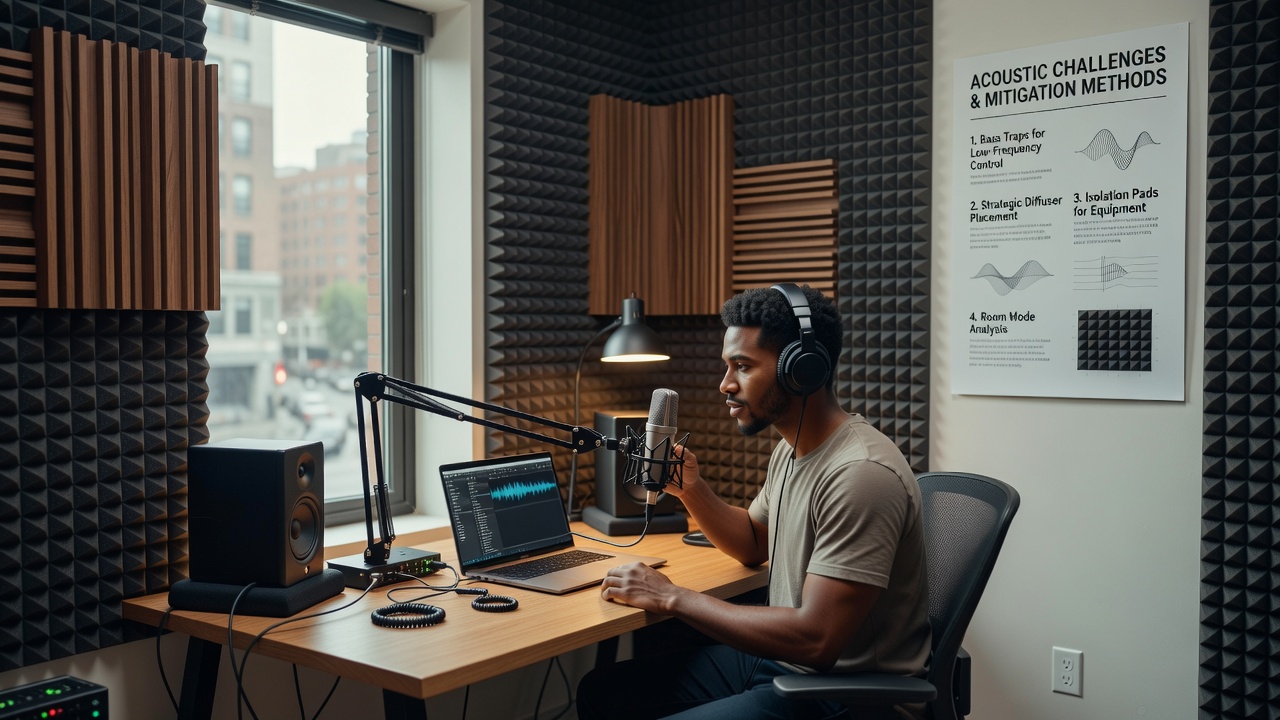
Independent creators working in tiny urban recording spaces face persistent acoustic challenges that stem from dense city environments and limited square footage. Traffic noise, neighboring conversations, and HVAC systems often penetrate thin walls while small room dimensions produce standing waves and flutter echoes that distort recordings. Data from urban noise studies indicate that city sound levels frequently exceed 70 decibels during daytime hours, creating interference that requires targeted mitigation rather than simple volume adjustments.
Primary Acoustic Issues in Compact City Studios
Researchers have documented how small rooms under 150 square feet amplify bass buildup along corners and walls because low-frequency wavelengths exceed the available space dimensions. This phenomenon leads to uneven frequency response where certain notes boom while others vanish during playback. Observers note that urban buildings constructed before modern soundproofing standards transmit mid and high-frequency sounds through shared floors and ceilings with minimal resistance, and this transmission becomes especially problematic during evening hours when surrounding activity peaks.
Studies conducted across multiple cities show that external noise sources such as delivery trucks, construction equipment, and public transit contribute irregular spikes that interrupt vocal takes and instrument tracking sessions. Those who have measured these interruptions report that even brief external sounds can require multiple retakes, extending production timelines by 30 to 40 percent in untreated spaces. Internal reflections within untreated rooms compound the problem by creating comb filtering effects that alter perceived timbre of recorded material.
Evidence-Based Mitigation Approaches
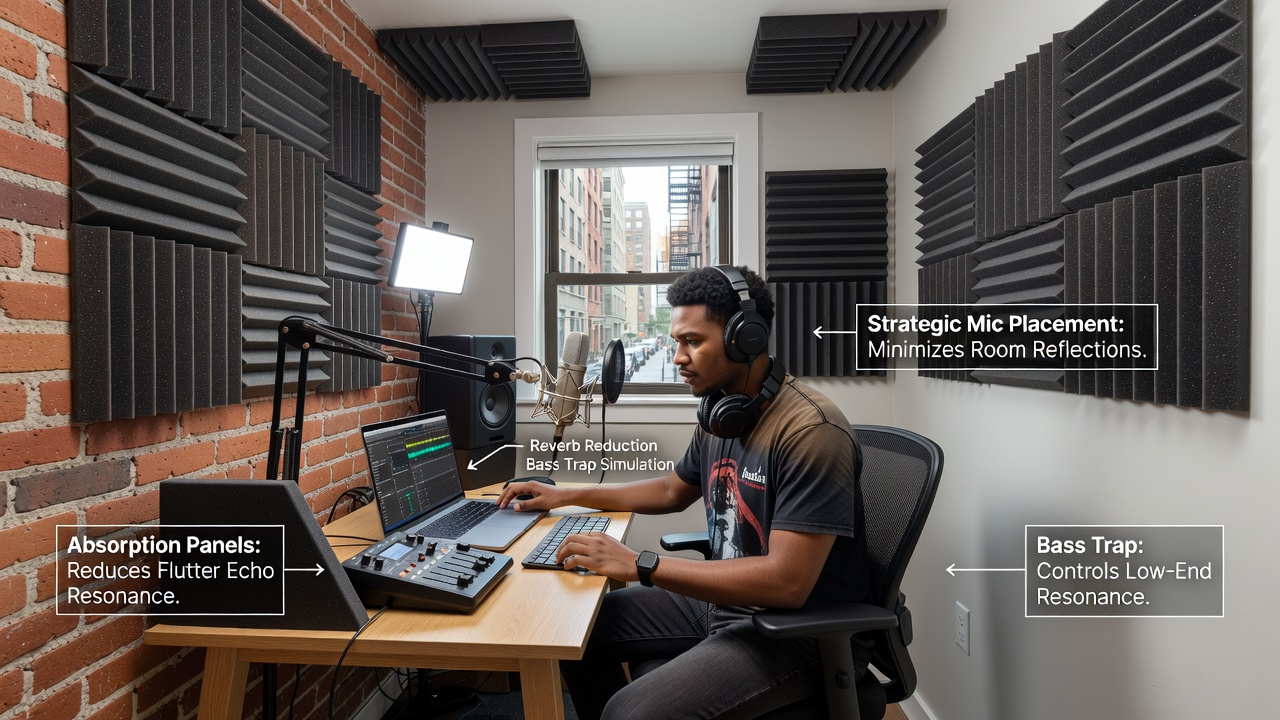
Acoustic treatment begins with identifying transmission paths through measurement tools such as sound level meters and frequency analyzers. Professionals often start by sealing gaps around windows, doors, and electrical outlets using weatherstripping and acoustic caulk because these openings allow direct sound leakage. Once external noise is reduced at the source path, attention shifts to internal reflections through strategic placement of porous absorbers and resonant devices.
Bass traps positioned in trihedral corners absorb low-frequency energy that otherwise accumulates, while broadband panels on first reflection points control midrange buildup without deadening the room excessively. Data from controlled tests reveal that combining membrane absorbers tuned to specific frequencies with fiberglass panels yields more balanced results than uniform coverage alone. Creators who apply these layered methods report measurable improvements in frequency response flatness within the 20 to 200 hertz range.
Advanced Techniques and Material Selection
Diffusion elements placed on rear walls scatter remaining reflections to maintain a sense of space without introducing new peaks or nulls. Research published in acoustics journals demonstrates that quadratic residue diffusers designed for specific frequency bands outperform random scattering patterns in rooms smaller than 200 square feet. Material choices matter because rigid panels reflect energy while soft furnishings absorb inconsistently across the spectrum.
Active noise control systems using microphones and speakers to generate opposing waveforms have entered testing phases for residential applications, and preliminary figures from pilot programs indicate potential reductions of 10 to 15 decibels in targeted frequency bands. These systems complement passive treatments rather than replace them because they function best against predictable, repetitive noise sources such as HVAC units. In September 2026 several research institutions plan to release updated guidelines on integrating active modules with traditional absorbers for urban micro-studios.
Practical Implementation Examples
One independent producer in a converted apartment bedroom documented a 25-decibel drop in external noise transmission after installing mass-loaded vinyl barriers beneath new drywall layers on shared walls. Another case involved a creator who combined ceiling cloud panels with floor isolation pads to address both airborne and structure-borne sound from upstairs neighbors. These examples illustrate how sequential application of barrier, absorption, and isolation techniques addresses multiple transmission paths within the same footprint.
Industry reports from acoustic engineering associations highlight that budget-conscious creators achieve comparable results by repurposing rigid fiberglass boards wrapped in fabric rather than purchasing pre-made panels. Calibration measurements taken before and after installation confirm that such DIY approaches reduce reverberation time from 1.2 seconds to under 0.4 seconds when coverage reaches 30 percent of total surface area.
Conclusion
Effective management of acoustic challenges in tiny urban recording spaces relies on systematic identification of noise paths followed by layered application of sealing, absorption, and diffusion methods. Ongoing research continues to refine material performance data and active control options, providing independent creators with measurable strategies that fit constrained environments. Those who implement these approaches based on empirical testing rather than trial and error consistently achieve clearer recordings that translate accurately across playback systems.